
An Alter Contacts guide
Clients note
A clients note is a record attached to one person after an interaction. It is not a transcript, not a QuickBooks or HoneyBook activity line, not a shared recap, and not a therapy SOAP note. Search results for the singular phrase often mean clinical documentation or accounting activity. This page is not for those audiences. The record belongs to one client, not to a session type or an invoice. For a financial advisor, a clients note is compact memory filed to a household after a call: what changed, what the advisor noticed, what was promised, when it should return, and where that information came from. Alter Contacts captures it by voice after the meeting, without a recording bot, and keeps the note on the person. The nearby plural page covers the broader practice. This URL is the awkward singular query and the record itself. Alter organizes advisor-provided context. It is not a compliance record and not an investment recommendation.
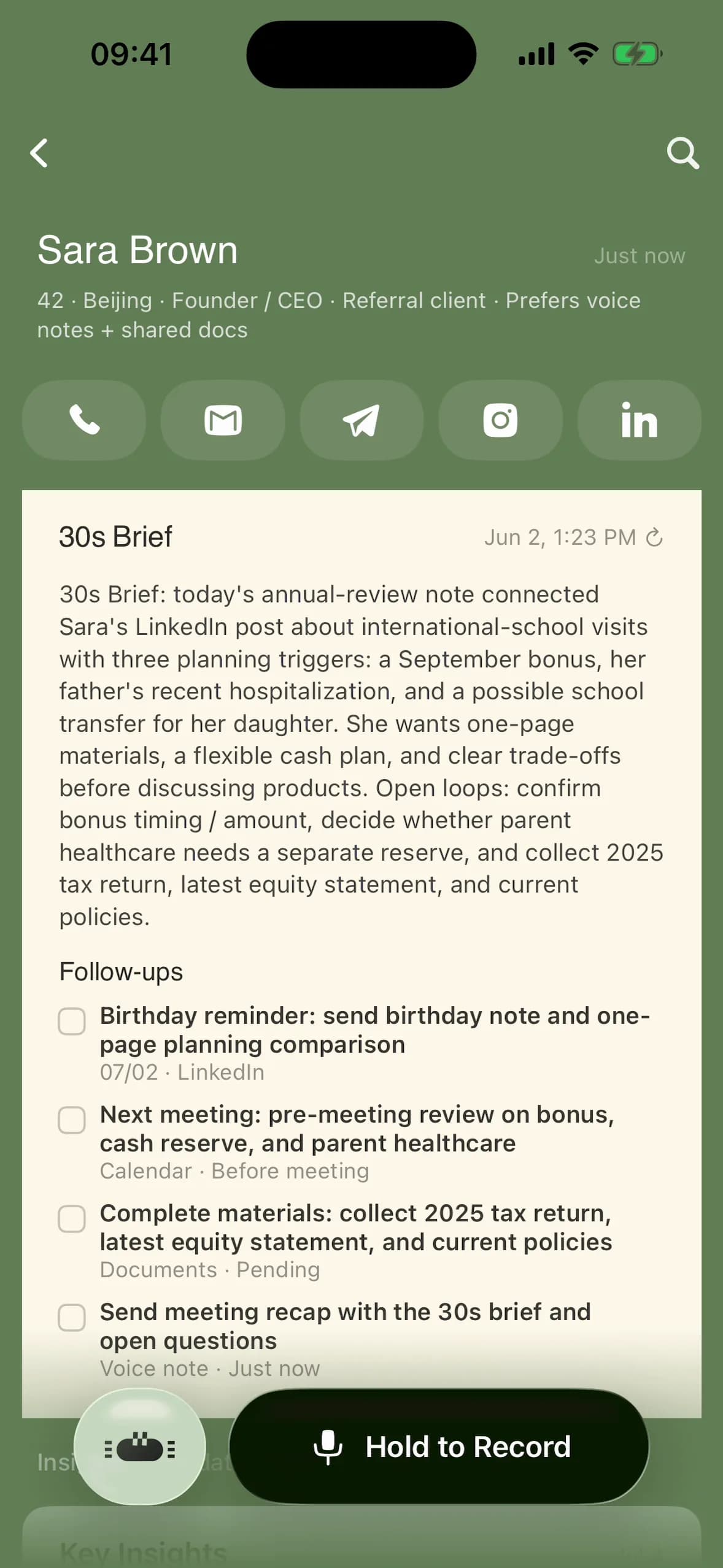
The fields a clients note actually needs
“If the note cannot say who said it, it is not ready to keep.”
A clients note is a small record with five working parts: a fact the client stated, an observation the advisor made, a promise someone owns, a date or an honest unknown, and a source for each of those. Mixing them is how a useful note becomes a transcript, a SOAP chart, or an activity line that future-you cannot trust.
The singular query is not the therapy query
People type “clients note” and land in the wrong profession.
The awkward singular is a real search. Google currently treats it as therapy SOAP, QuickBooks client notes, HoneyBook activity, or a generic tracker. Those products serve clinicians, bookkeepers, and creative studios. They are not a record for an established wealth, insurance, or financial advisor who just left a household conversation.
Advisors already have places a note could go: the CRM activity feed, a planning platform, email, a notebook. The friction is the same each time. A call ends, the next one starts, and the detail waits. When it is finally typed, the fact, the observation, and the promise have been flattened into one paragraph that is hard to reuse.
Alter Contacts treats a clients note as a record attached to one person after an interaction. Hold to speak. Separate the fact from the observation. Attach the promise, the date, and the source. The nearby plural page is the broader client-notes practice. This page is the object itself: one client, one note, enough structure that the next conversation can start from it.
How to capture a clients note
Five steps from an open client to a record you can trust later.
The order matters. Open the person first so the note cannot drift into a shared inbox, a SOAP chart, or an accounting feed.
- 01
Open the client
Start on the person the relationship belongs to. A clients note that is not attached to one client is already a transcript, a recap thread, or an activity line. Opening the client is the filing step, not a later cleanup task.
- 02
Hold to speak
After the interaction, hold to speak. Describe what happened in the language you would use with a trusted assistant. You do not need a form, a SOAP heading, or a polished paragraph. The note is an input.
- 03
Facts
Say what the client stated: a date, a document, a move, a decision, a question. Keep it as their statement. A clients note that upgrades a passing remark into a firm fact is already the wrong record.
- 04
Observation
Then say what you noticed: hesitation, emphasis, a mismatch between the question and the concern. Label it as your observation. Future-you should be able to see the difference without rereading the whole note.
- 05
Promise, date, and source
Close with what was promised, when it should return, and where the information came from—this voice note, a call, a meeting, a message. If the date is unknown, keep it unknown. Alter can organize those fields; the advisor still reviews them before acting.
A fictional clients note
One person. One interaction. Five fields.
A short call about a retention bonus also includes a family change. The clients note has to keep the fact, the observation, and the promise from collapsing into a single activity line.
Raw advisor note
“Elena. She received a retention bonus in March and asked whether to add it to the existing taxable account. She also said her brother is moving in for six months after a job loss. She asked about the bonus twice and mentioned her brother only at the end. I promised a one-page bonus-placement sketch by Wednesday. Source: this post-call voice note.”
Structured memory
Fact: retention bonus in March; brother moving in for six months after a job loss. Observation: she asked about the bonus twice and raised the brother only at the end. Promise: one-page bonus-placement sketch by Wednesday. Date: Wednesday for the sketch; six months for the household change. Source: advisor voice note after the call.
Possible next action
Keep the note on Elena, preserve the observation as an observation, and return the Wednesday sketch with the original source attached.
This example is fictional. Alter organizes advisor-provided context and is not a compliance record or an investment recommendation.
What “clients note” usually means, and what it means here
The nearby tools are real. They are the wrong audience.
A clients note in Alter is a record attached to one person after an advisor interaction. It is not clinical SOAP, not bookkeeping, not studio ops, and not a CRM activity dump.
Intuit QuickBooks client notes
Notes attached to a customer inside accounting and invoicing workflows.
Built for bookkeeping context, not for post-call relationship memory after an advisor conversation.
HoneyBook
Client activity and notes for creative businesses and studios.
Project and booking ops. Not a voice-filed record for a wealth, insurance, or financial-advisor household.
Client Note Tracker
A generic place to store notes against names.
Storage without the fact / observation / promise / date / source split, and without a follow-up that still carries its reason.
Therapy SOAP tools
Clinical session notes with Subjective, Objective, Assessment, and Plan.
Wrong audience. This page is not for therapists. A clients note here is not a SOAP chart and not a treatment record.
CRM activity feed
Official chronology on the household, visible to the firm.
Often written late, optimized for documentation, and buried as another activity rather than a compact record future-you can use.
Alter Contacts
A clients note captured by voice after the interaction and filed to one person, with fact, observation, promise, date, and source kept distinct.
It does not replace the official CRM note, a required archive, or any clinical or accounting product.
One person, proportionate detail
Attach the note to the client. Do not chart the client.
A clients note should be small enough to reuse and careful enough to trust. Alter starts with what the advisor deliberately provides, keeps source visible, and leaves confirmation to the professional when identity or meaning is unclear.
- 01This is not a transcript, not a SOAP note, and not an accounting activity.
- 02Keep client-stated facts distinguishable from advisor observations.
- 03Alter organizes advisor-provided context; it is not a compliance record or an investment recommendation.
- 04Review structured fields before using them in a client-facing or official process.
Questions advisors ask
Practical answers, without the product fog.
01What is a clients note?
A clients note is a record attached to one person after an interaction. In Alter Contacts it holds a fact, an observation, a promise, a date, and a source, filed to that client rather than to a transcript, a recap thread, or an activity feed.
02Is this a therapy SOAP note?
No. Search results for “clients note” often mean clinical SOAP documentation. This page is not for that audience. Alter Contacts is for established wealth, insurance, and financial advisors capturing relationship context after a call, not session notes for therapy.
03How is this different from QuickBooks or HoneyBook client notes?
QuickBooks attaches notes to accounting customers. HoneyBook attaches notes to studio and project clients. A clients note here is advisor-authored memory for a household after an interaction: voice in, structure after, filed to the person. It is not bookkeeping and not creative-ops activity.
04How do I capture a clients note in Alter?
Open the client, hold to speak after the interaction, state the facts, label your observation, then add the promise, date, and source. Alter organizes those fields under the person. You still review them before acting.
05Is a clients note the official compliance record?
No. Alter organizes advisor-provided context. It is not a compliance record and not an investment recommendation. Firms decide how a useful note is reviewed and transferred into their approved CRM or archive.
Keep the next promise visible
Remember the client. Then make the next move count.
Alter Contacts guides