
An Alter Contacts guide
Client notes that become useful before the next conversation.
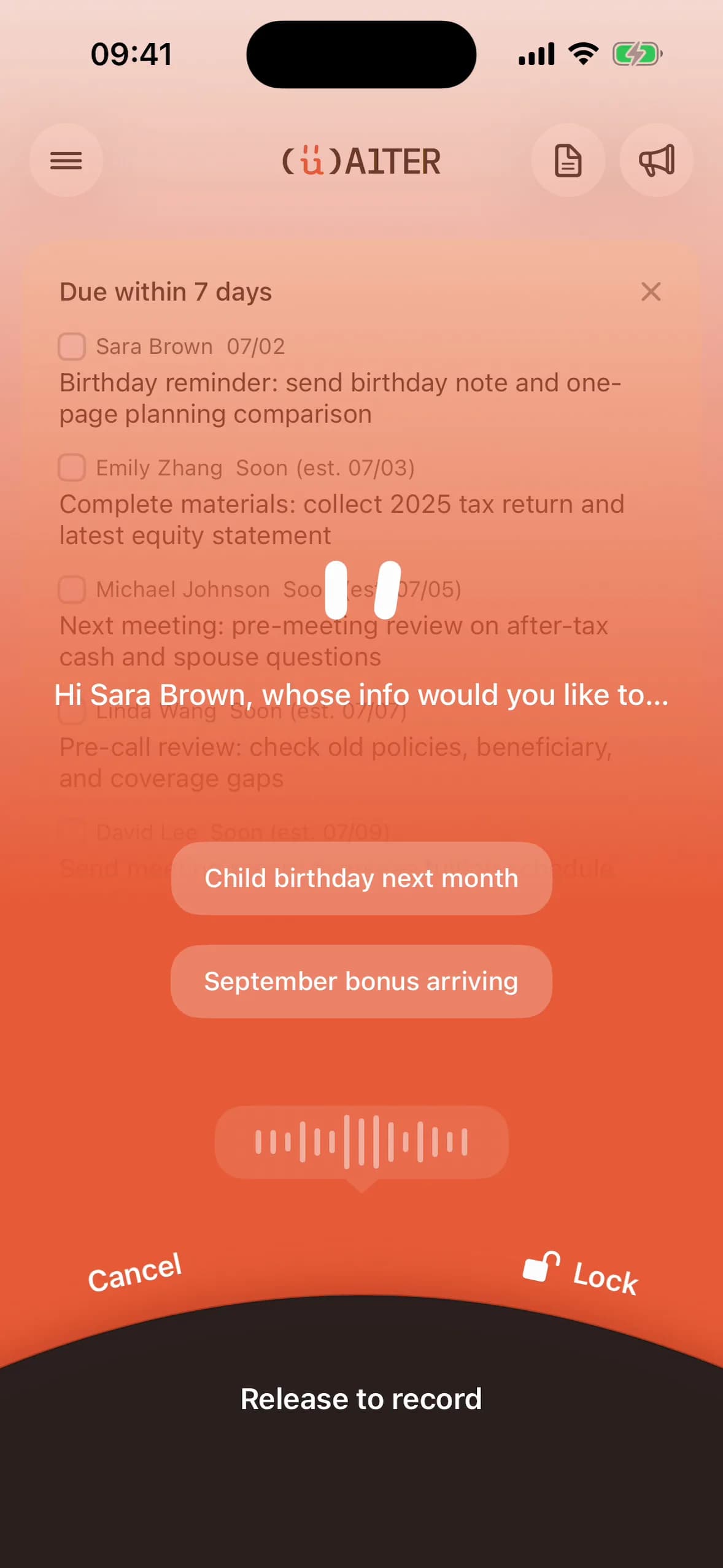
Capture the thirty seconds after a client call, when the important detail is still fresh. Alter Contacts turns a rough voice note into relationship memory you can find, understand, and act on later.
A better definition of a client note
“A note is only valuable if future-you can use it.”
A verbatim transcript may preserve every word and still fail to answer the practical questions: What changed? What did the advisor promise? What remains uncertain? When should this return? A good client note is a compact piece of relationship memory with enough evidence and structure to support the next interaction.
Why client notes disappear
The hard part is not writing. It is capturing context before it decays.
Most advisors already have several places where a note could live: the CRM activity feed, a planning platform, email, a notebook, a document folder, or a phone. The choice creates friction at exactly the wrong moment. A call ends, the next appointment begins, and the advisor tells themselves they will write the proper note later.
When later arrives, the formal facts survive but the relationship texture is gone. “Discussed retirement” replaces the concern in the client’s voice. “Send information” replaces the exact asset promised and the reason it mattered. A future advisor, assistant, or even the same person three months later can see that something happened but cannot confidently continue it.
Alter Contacts treats the post-call moment as the capture point. You can speak in fragments, correct yourself, and include the personal detail that would feel awkward in a rigid form. The product then organizes what you said into a client profile, interaction history, commitments, and possible follow-up instead of asking you to pre-structure your thinking.
From voice note to client memory
Use a low-friction input without accepting a low-quality record.
The workflow separates capture from organization. The advisor stays present in the client conversation, then speaks while recall is still accurate.
- 01
Capture the fresh version
Open Alter after the interaction and describe what mattered in your own words. Include client-stated facts, your observations, open questions, promises, and dates. The note can be rough because it is an input, not the final client record.
- 02
Separate meaning from noise
Alter identifies the client and organizes the note into useful categories. Facts remain distinguishable from advisor judgment. Commitments and dates become explicit. Uncertain ownership or meaning can be surfaced for confirmation instead of being presented as fact.
- 03
Return in context
Before the next conversation, the client profile shows what changed and what remains open. When a promised action approaches, the note returns with the source and enough surrounding context to make the follow-up personal and specific.
A fictional post-call note
The useful detail is often hidden inside an ordinary recap.
A client calls with a routine question about a beneficiary form. During the conversation, they also mention a job change that could affect several future planning conversations.
Raw advisor note
“David will send the signed beneficiary page on Friday. He also said he accepted the role in Denver and expects to move in January. His spouse is staying in Chicago until the school year ends. I said I would send a relocation planning checklist next week.”
Structured memory
Open document: signed beneficiary page, expected Friday. Life event: new Denver role and phased household move. Advisor commitment: relocation planning checklist next week. Future context: spouse remains in Chicago through the school year.
Possible next action
Create the promised checklist follow-up and preserve the household timing for the next review, without treating the advisor’s assumptions as client-stated facts.
This example is fictional and demonstrates note organization only. It is not financial, tax, legal, or investment advice.
Choose the capture method deliberately
Different note tools preserve different kinds of value.
The best system is the one advisors actually use and can retrieve later. Alter is optimized for fast capture plus future relevance.
Handwritten notebook
Natural during a conversation and flexible for personal thinking.
Hard to search, share responsibly, or connect to a timed follow-up.
CRM activity note
Attached to the official client record and visible to the firm.
Often written late, optimized for documentation, and buried in chronological activity.
Meeting transcript
Detailed account of a recorded conversation.
Long to review and unavailable for calls or moments that were not recorded.
Alter voice note
Fast advisor-led capture that becomes structured relationship context.
Should complement, not bypass, the firm’s approved recordkeeping process.
Keep notes useful and proportionate
Capture what supports the relationship, not everything a client has ever said.
More data is not automatically better memory. A useful client-note practice is deliberate about relevance, source, sensitivity, and retention. Alter is built to preserve evidence and uncertainty rather than turn every inference into a permanent fact.
- 01Record who said what and distinguish client statements from advisor observations.
- 02Attach owners and timing to open actions instead of leaving vague reminders.
- 03Avoid unnecessary sensitive details and follow your firm’s approved procedures.
- 04Review generated structure before relying on it for a client-facing or regulated action.
Questions advisors ask
Practical answers, without the product fog.
01What should financial advisor client notes include?
A useful note usually identifies the interaction, participants, client-stated changes, important questions, explanations given, open items, owners, dates, and the next agreed action. The right level of detail depends on the interaction and the firm’s procedures. The note should make the next conversation easier without mixing fact, observation, and inference.
02Can I use Alter Contacts without recording the meeting?
Yes. One of the main use cases is a short voice note immediately after the meeting or call. You decide what mattered and capture it in your own words. That is useful when a full recording is unnecessary, unavailable, or not part of the firm’s approved process.
03How is this different from Apple Notes or a voice memo?
A general note or voice memo preserves the input. Alter is designed to connect that input to the right client, organize facts and commitments, build a living profile, and return the context when an action becomes relevant. General tools can still be useful, but the advisor must supply the organization and timing.
04Can client notes create follow-up reminders?
When a note contains a commitment, date, life event, or open item, Alter can turn that context into a visible next action. The reminder retains the reason behind it, so the advisor sees more than a generic task such as “call client.”
05Are Alter Contacts notes the official compliance record?
That depends on the firm’s systems, jurisdiction, and approved procedures. Alter does not claim to replace a required CRM activity, books-and-records archive, or supervisory workflow. Firms should decide how useful context from Alter is reviewed and transferred into their official process.
Keep the next promise visible
Remember the client. Then make the next move count.
Alter Contacts guides