
An Alter Contacts guide
A follow-up tracker that remembers why now matters.
Alter Contacts keeps promises, planning windows, cooling relationships, and personal milestones connected to the client context that made them important in the first place.
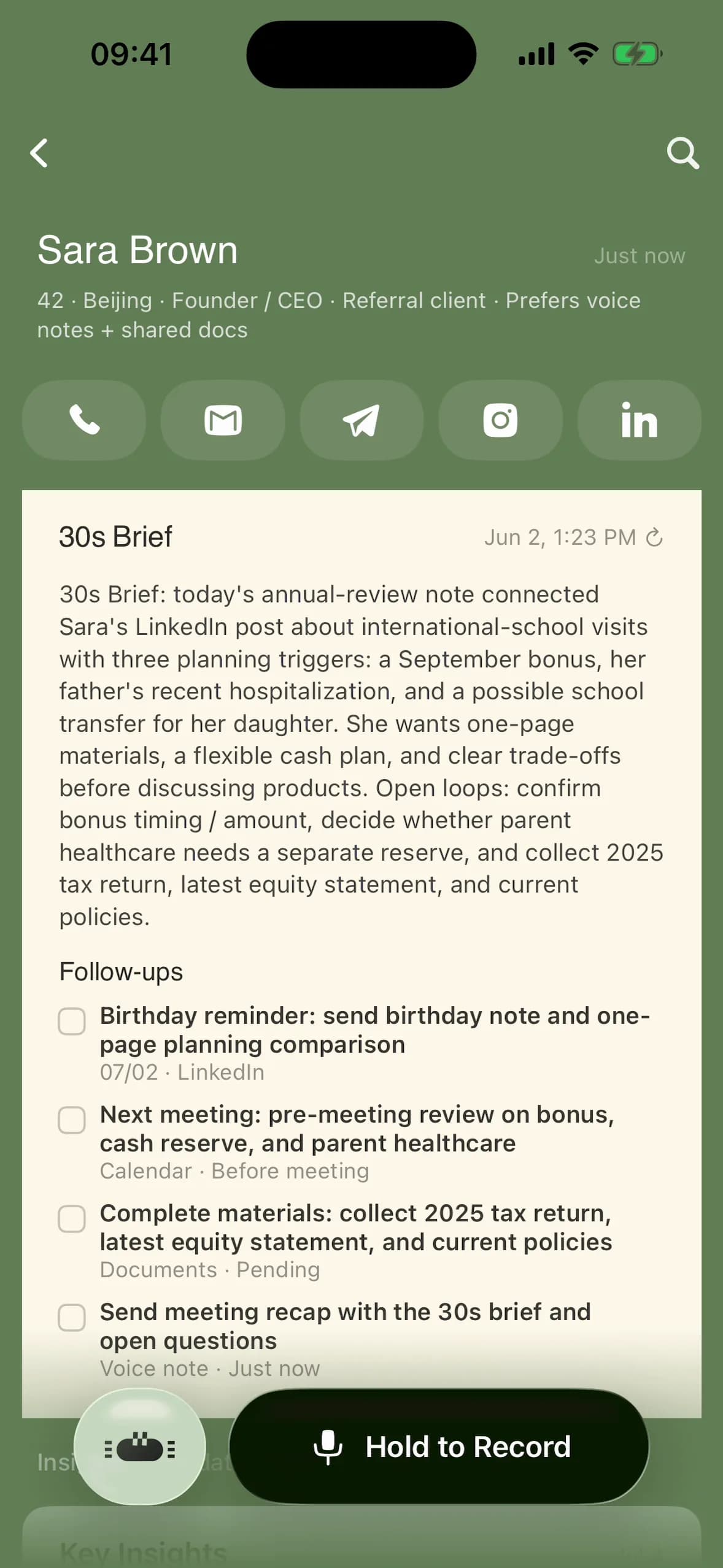
The task-list trap
““Call client” is not a next action. It is a reminder that lost its memory.”
A date alone can tell an advisor when to act, but not what to say. Useful follow-up needs the promise, the client’s situation, the source, and the intended outcome. Without that context, tasks are postponed, rewritten, or completed with a generic message that does little to strengthen the relationship.
Why good intentions turn into missed follow-up
Follow-up breaks when the action and the conversation live in different places.
An advisor may leave a meeting with three kinds of next step: something promised to the client, something the client must provide, and something worth revisiting when the timing changes. These are often divided between a CRM task, an email draft, a handwritten note, and the advisor’s memory. Each location preserves one part of the job while losing the whole picture.
Traditional task managers make the problem visible but rarely preserve the relationship logic. “Review insurance” does not explain whether the trigger was a new child, an expiring policy, a business change, or a passing concern that needs validation. When the reminder appears weeks later, the advisor must reconstruct the conversation before acting.
Alter keeps the action attached to client context. The daily attention queue can surface explicit commitments, near-due actions, long gaps, renewals, birthdays, and life events. Each item is meant to answer four questions quickly: Who? Why now? What evidence supports this? What could I do next?
A contextual follow-up loop
Move from promises to timely, personal action.
Alter does not ask advisors to maintain a parallel project-management system. It extracts possible actions from the same context they already capture.
- 01
Capture the commitment
Say what you promised, what the client promised, and any timing discussed. If timing is unclear, preserve that uncertainty rather than inventing a deadline. The original interaction remains available as evidence for the structured action.
- 02
Watch for the right trigger
Some actions have a date. Others depend on a relationship gap, a renewal window, a review cycle, or a life event. Alter organizes those signals so the next step can surface when it becomes relevant instead of when the advisor happens to remember.
- 03
Review and act
The queue shows the client, the reason, and a possible action. The advisor can inspect the source, adjust the timing, prepare a message, schedule the next step, or mark the item complete. Nothing needs to be sent automatically.
A fictional follow-up chain
One conversation can contain several clocks.
During a review, a client mentions an expiring business lease, an unsigned document, and an upcoming family milestone. Each deserves a different kind of attention.
Raw advisor note
“Maya will upload the signed trust amendment Friday. Her studio lease renews in March, but she expects to decide whether to expand by December. Her father turns eighty in November, and she wants to revisit care planning before the holidays.”
Structured memory
Client action: trust amendment, expected Friday. Decision window: studio expansion by December, lease renewal in March. Family milestone: father turns eighty in November. Planning topic: care planning before the holidays.
Possible next action
Check for the document after Friday, surface care planning before November, and retain the December/March business timeline without collapsing it into one vague “follow up” task.
This is a fictional workflow example. Dates, people, and circumstances are illustrative and do not represent a real client.
Follow-up systems compared
Visibility helps. Context makes the action usable.
Advisors do not need every task in one new tool. They need relationship actions to retain enough meaning to survive the time between conversations.
Calendar reminder
Clear timing and familiar notifications.
Usually contains little client history or evidence for why the reminder exists.
CRM workflow
Firm-wide assignment, process visibility, and repeatable service steps.
Can be heavy for small contextual promises and relationship signals.
Task manager
Fast capture, ownership, status, and project views.
Client context fragments unless the advisor manually maintains links and notes.
Alter attention queue
Client, timing, evidence, and a possible next action stay together.
It is not a substitute for required firm workflows or official task supervision.
Attention without autopilot
A relationship signal should invite judgment, not trigger an automatic message.
A birthday, a long contact gap, or a life event can be a useful reason to pay attention. It is not always a reason to contact the client. Alter is designed to provide context and a draftable next step while leaving timing, tone, suitability, and channel to the advisor.
- 01Explicit promises should stay distinguishable from inferred opportunities.
- 02The advisor can review source context before accepting a suggested action.
- 03Sensitive milestones should be handled according to client expectations and firm policy.
- 04Completed actions should not erase the interaction history that explains them.
Questions advisors ask
Practical answers, without the product fog.
01What is a client follow-up tracker?
A client follow-up tracker records who needs attention, what action is expected, who owns it, and when it should happen. A context-aware tracker also preserves why the action matters and where it came from. That makes it easier to continue the relationship without rereading every old note.
02How is Alter different from CRM tasks?
CRM tasks are valuable for official workflows, assignments, and repeatable service processes. Alter focuses on the conversational context around the action: the client’s concern, the promise made, the supporting evidence, and the relationship signal. The two can complement each other rather than compete.
03Can Alter remind me when a client relationship goes quiet?
Alter can make long contact gaps and cooling relationships visible alongside other signals. A gap is context, not proof that outreach is appropriate. The advisor reviews the client history and decides whether a call, message, meeting, or no action is the right response.
04Does Alter automatically send follow-up emails?
No. Alter can help prepare the next move, but the advisor reviews and initiates client communication. That keeps judgment over timing, channel, wording, and regulatory requirements with the professional responsible for the relationship.
05Can a follow-up come from a voice note?
Yes. A short post-call voice note can include an advisor commitment, a client-owned task, or a future planning window. Alter can organize those elements into visible next actions while keeping the raw context available for review.
Keep the next promise visible
Remember the client. Then make the next move count.
Alter Contacts guides